Wednesday, June 19, 2013

Mirrorless Interchangeable Lens System Cameras

In the last few years a new breed of camera has been born.  It can be very DSLR-like or it can be Point and Shoot-like.  Current nomenclature uses Mirrorless Interchangeable Lens System or MILS to designate this type of camera although the name is still evolving.  They are made by Panasonic, Olympus, Samsung, Pentax, Nikon, and Sony.  MILS cameras do not have a mirror that must flip out of the way as a photo is being taken.  This allows the body form to be be smaller.  Smaller is better if you are on a long hike.

One class of MILS cameras, made by both Panasonic and by Olympus is called the Micro Four Thirds cameras. They all share is the use of a 4/3 size sensor that is slightly smaller than the APS-C sensor used by Canon and Nikon.  Using the M4/3 sensor results in a crop factor of 2.0 for lenses.  The kit lens is a 14-42mm lens which has the same field of view as a 28-88mm on a camera using a full frame sensor.  The first m4/3 sensors were 12 megapixels in resolution.  The later models have stepped up to 16 megapixels. And you can interchange Oly and Panny lenses from one brand to the other.  With the proper adapter you can also hang almost any camera lens on a micro-4/3 camera. When you use an adapter, you lose the auto-focus function.  I have several Pentax K-mount lenses that do a great job as manual focus lenses.  There is a complete suite of auto-focus lenses made by Panasonic and Olympus that fit the M4/3 cameras.

I own a Panasonic G2.  It looks very much like a small DSLR but when you use the viewfinder you are actually looking at a small electronic screen.  Like with a DSLR, you see the camera settings as well as the subject that you are photographing.  The M/43 cameras take excellent videos as they have full time autofocus in the video mode.

When you are using it with non-M4/3 lenses and are using manual focus, you can get an enlarged view through the viewfinder to assist with manual focus.  Although one can use auto-focus lenses of other brands (with the proper adapter) it is difficult to set the f/stop of an auto-focus lens because AF lenses don't have an aperture control band on the lens.  Most older manual focus lenses have the control band and it is very easy to set the aperture.  One additional thought about the MF lenses is that  they are very inexpensive and it is also easy to find "fast" lenses.  As an example I was able to acquire a 135mm f/2.8 lens for only $25.00.

Some photos of my G2.


 Here is a photo of my G2 with a K-Mount 70-200mm Promaster mounted on it.


Here are some photos taken by the G2 with a Pentax 50mm, f2.0 mounted on it.


That is about it until I take some more photos.   Have a great summer day.


Saturday, June 8, 2013

Grand Canyon 43rd Anniversary Trip

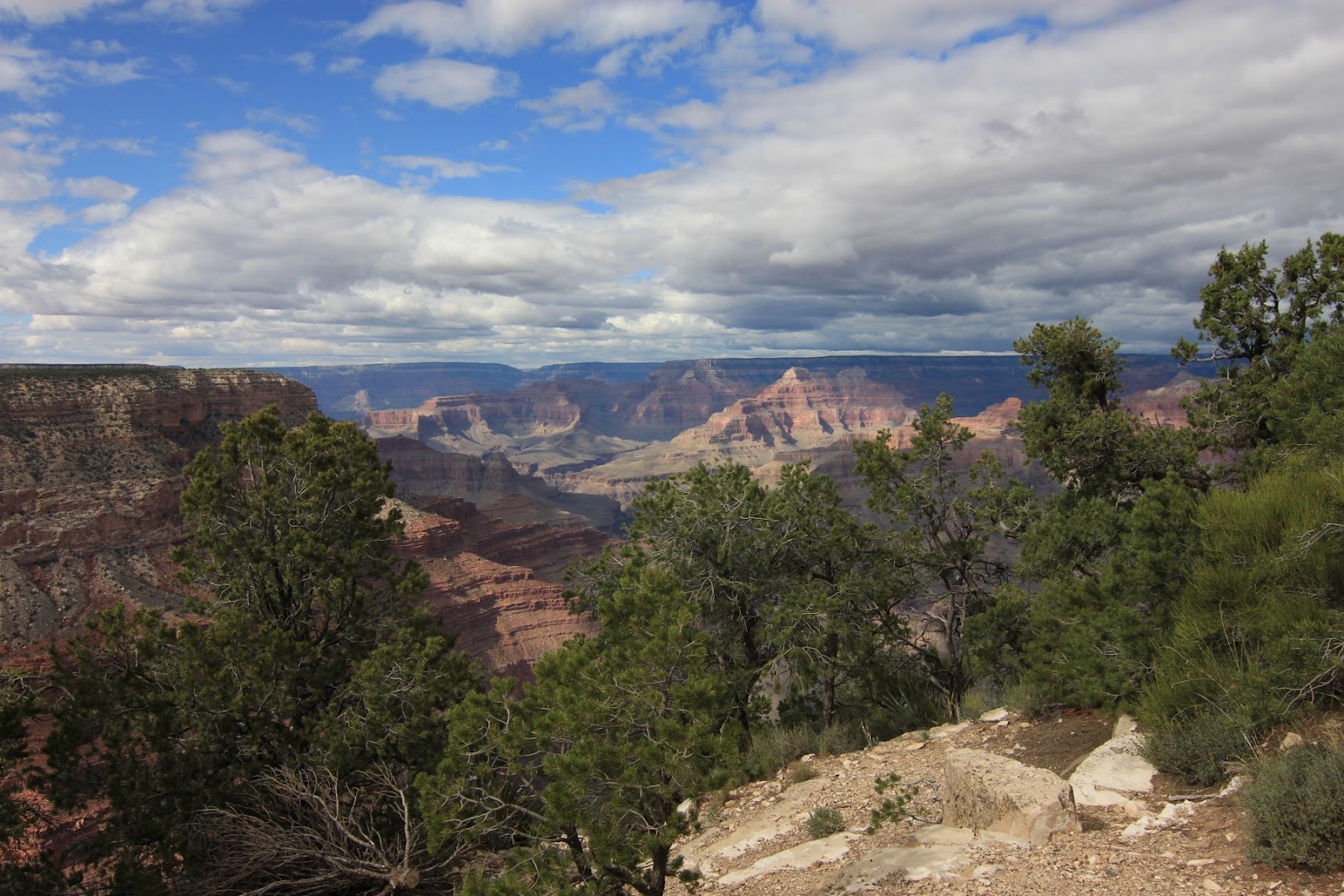
Once again we made our way back to the Grand Canyon.  Every trip is different in feel and look.  This trip the first day was snowy and the next two were clear.  We saw Elk, which have never before put in an appearance for us.

I'll post some photos that are a mixture of digital and scanned film shots.  The film and Minolta 3Xi camera reacted really well with early morning sun and gave some stunning photos.

View west from the El Tovar terrace.  


View North from Hopi Point.
 

View East from the Yavapai Ranger Station.


View down into the Inner Gorge and Bright Angel Canyon with a view of Phantom Canyon Ranch.


A couple of elk photos.


One thing about the Grand Canyon is that it is very dark at night.  I took advantage of that and tried my hand at astrophotography.  Here is a shot.  In the lower left of the photo you can see the Orion nebula,  the sword points down toward the corner.  In the upper right of the photo you can see the Pleiades, a closely spaced group of 7 stars in a region where new stars are being born.


Tuesday, March 6, 2012

Grand Canyon Vehicle Shuttle Trip


In October Eileen and I and our friends Kaye and Asghar Shariff shuttled hiker vehicles from the North Rim of the Grand Canyon to the South Rim.  Along the way we toured Lee's Ferry national monument and had some great meals.

When we left Phoenix it was still summer.  By the time we reached the North Rim it had turned to winter complete with snow.  Luckily there wasn't much snow sticking to the roads so we had free roaming capability.

Below are some photos from our trip.  I was shooting my Canon 60D and a Rolfix folding 120 film camera.  I will identify which camera took which photo.

First is a photo of we four travelers.  I photoshopped myself into the photo.

Left to right Larry, Kaye, Asghar, and Eileen.

Snowy weather on the way into the park.
View from the canyon side of the lodge.
At Point Imperial the next morning.
Snow covers the countryside.

After getting through morning cleanup we had a great breakfast at the Lodge dining room and went out looking for other great sights.

One of the first things we came upon was a flock of wild turkeys warming up near the road.  Funny birds.  Not as large as the supermarket ones.
All along the road were turnouts that offered spectacular views.
The next viewpoint is Angel's Window.  You can see the Colorado river through the window.
At the end of this road is Cape Royal.
We then picked up the other two vehicles and began our journey to the South Rim.  We spent the night in an older motel at Lee's Ferry.  Lee's Ferry operated from the 1800's until the early 1900's.  It was a main route for Mormon families migrating out of Utah into southern Arizona.  Lee's Ferry is now a prime put-in for anglers and rafters.
Vermillion Cliffs
 Vermillion Canyon at Lees Ferry

Rafters getting ready for their trip down the Colorado River.
The next morning we got an early start and drove 60 miles to Cameron where we had a great breakfast at the Cameron Trading Post.  Tip: If you order the Navajo Taco, the small order is large enough for any 2 reasonably hungry people.  The turn to the South Rim of the Grand Canyon is about a mile south of the Cameron Trading Post.
The Cameron Trading Post is full of curios, Navajo art and jewelry, and munchies.

The restaurant in the Cameron Trading Post features a large fireplace, bins which were used to store trade goods and a metal ceiling.


Asghar was feeling good after breakfast and a cup of coffee.
On entering the Grand Canyon National Park from the east end, the first thing you see is the Desert Watchtower.  The Watchtower was designed by noted architect Mary Jane Coulter who also built most of the structures at the Grand Canyon Village.
In this view, looking northeast from the Desert Watchtower, you can see Lee's Ferry where we began the morning's journey.

We continued our journey westward to Grand Canyon Village where we dropped off the hiker's vehicles.


Kaye and Asghar at a viewpoint.


The view from Moran Point.

At the Yavapai Ranger Station you can look down over the edge from inside a building.  Exhibits of the rock layers in the Canyon are available for touching and Rangers give talks on how the Canyon was developed and the critters that live in the Area.

At the far western end of the south rim road is a structure known as Hermit's Rest.  Its a stone building with a very large fireplace.  A cup of hot chocolate is a nice respite from the cold weather when visiting in the winter.

 Notice the man sitting next to the firepit.

The view from Hermit's Rest.

We left the Park after visiting Hermit's Rest.  We journeyed down to Williams, AZ which is the base for the Grand Canyon Railway, and had dinner at the Pine Country Cafe.  From there we motored home to Phoenix.

Mother Nature had one more surprise for us.  As we approached Flagstaff, AZ on I-40 the tops of the San Franciso Peaks were shrouded in clouds that glowed with an unnatural sunset glow.


Thursday, March 1, 2012

More Barrel Racing

We had another opportunity to  photograph horses and riders at a barrel racing event.  There were more riders at this event.  The event was also a daytime event with clear skies and cool temperatures.  It took place at Horse Lovers Park in northern Phoenix. 

I was able to stand at the fence and shoot from ground level.  Because it was daylight I was able to set the shutter speed to 1/1000th of a second and let the camera choose the F/stop.  I was using my Canon EF 28-70mm f/2.8 L lens mounted on a Canon 60D. I also dialed in an ISO setting of 200.   These settings enabled me to freeze the action in the race. 

Some representative photos are posted below:


Tuesday, November 22, 2011

Kid Soccer

Grand kids Brayden and Sophia have been playing youth soccer.  The season has progressed through 9 games.  I have been to most of the games and taken lots of photos.  I'll show you some of the photos a bit later but here are some things I have learned about getting good photographs.

Day Games:  In one sense day games are easier to shoot.  There is a lot more light which means you can use higher shutter speeds to "freeze" motion and still use a fairly low ISO setting.  A low ISO setting means you can avoid noise in your photo that ends up looking like "grain" from high speed film.  You can use almost any lens in the day.  I like a fairly long focal length so you can keep the point of action (the ball) at a large enough size on the frame to recognize what is going on.  I have used a prime lens and the size of the action varies as the ball moves up and down the field.  

Night Games:  The park where the soccer is played in Mesa, AZ has nice lighting.  Here I do use a 85mm f/1.8 lens because of its light gathering power.  In order to come close to freezing action at night, I have had to adjust the ISO up into the noisy range.  I found that setting ISO at 3200 or 5000 will give me a shutter speed of 160th to 200th of a second.  Those shutter speeds freeze most action but sometimes feet or hands will exhibit motion blur. 

The Players:  Sophia is 5 years old.  She aggressively follows the ball and dukes it out with the other team to take possession.  Brayden  is 6 years old.  He is very athletic and enjoys running up and down the field. 

Sophia Goes For The Goal
Sophia moves the ball.

Sophia and her team mates.

Brayden.

 Brayden on goal.

Brayden after the ball.

One other thing:  Crop your photos.  Sometimes the action gets lost in the clutter of the full frame.  Crop the full frame to isolate the action.